
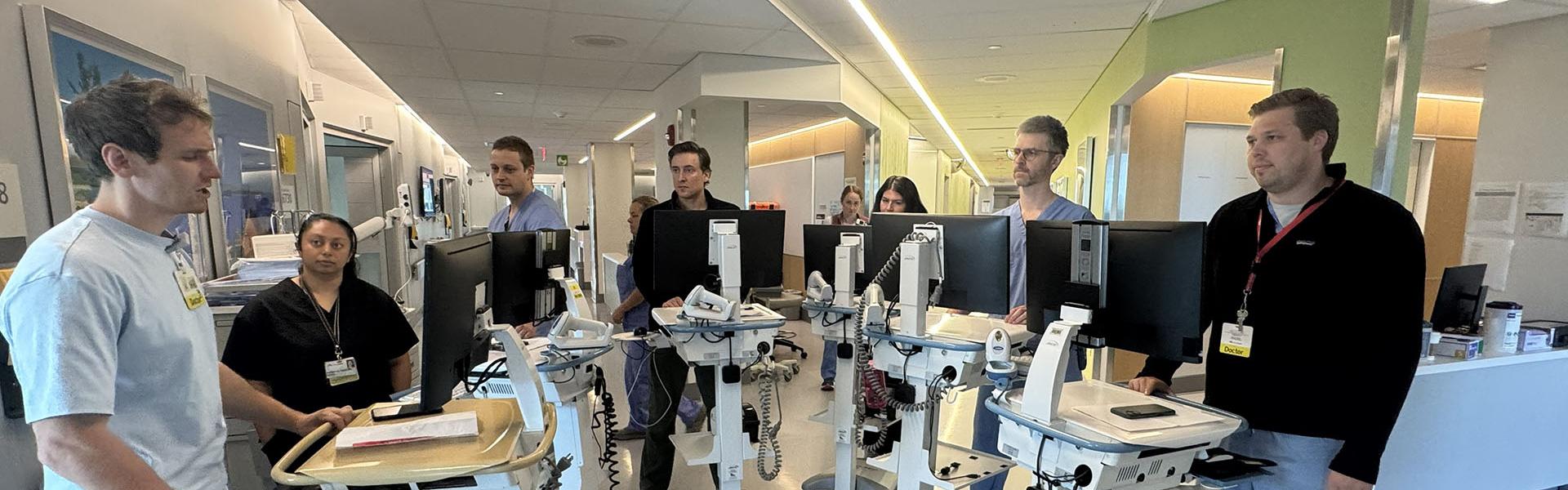
Our two year curriculum includes:
- 8 blocks medical intensive care
- 2 blocks surgical intensive care
- 2 blocks neurocritical care
- 2 blocks cardiovascular critical care (surgical and medical)
- 12 blocks electives/research (Anesthesia, Research, Medical Electives, etc.)
- MaineHealth actively conducts Critical Care research with a robust program. Faculty participate as lead investigators in both multicenter and local trials with opportunities for fellows to participate in established trials or initiate their own projects. Support for fellows is available along every phase of a study.
- MaineHealth offers a fellow level Clinician Educator Leadership Track (CELT) for those looking to further their skills as a medical educator
- Quality Improvement: Quality Improvement (QI) is integral to fellowship training and an important element of Critical Care Medicine. The MaineHealth ICUs continuously participate in QI initiatives with fellows often developing and implementing projects to improve the delivery of care.
- Weekly conferences: core curriculum series, critical care research, internal medicine grand rounds
- Monthly conferences: simulation (cognitive and procedural), journal club, morbidity & mortality, fellows’ case presentations, critical care grand rounds, multi-disciplinary ECMO
Current Rotations
Below is the current rotation plan for the year; schedules are subject to vary year-to-year. Fellows also work an average of 1 weekend/month including days and nights.
Year 1 | Year 2 | |
| Medical ICU | 9 weeks | 10 weeks |
| Nights | 7 weeks | 6 weeks |
| Pulm Consult | 4 weeks | 2 weeks |
| Neurocrit | 4 weeks | 4 weeks |
| Surg ICU | 2 weeks | 2 weeks |
| CICU | 2 weeks | 2 weeks |
| CTICU | 2 weeks | 2 weeks |
- 1500 – 1700 Tuesdays: Combined Pulm/CCM and CCM core curriculum didactic sessions
- 1230 1st Tuesday: Journal Club
- 1230 2nd Tuesday: Case conference
- 1230 3rd Tuesday: Morbidity and Mortality
- 1230 4th Tuesday: Monthly CCM fellowship meeting
- 1230 5th Tuesday: Board review, classic article review, potpourri
- 1200 Wednesdays: Weekly Department of Medicine Grand Rounds
- 1200 Fridays: Neurocritical care rounds –imaging review
- 1300 1st or 2nd Monday: Simulation laboratory on the MaineHealth Brighton Campus
- Ultrasound curriculum (embedded into didactic schedule)
- 0800 3rd Thursday (every other month): ECMO conference
- 1600 1st Thursday: Critical Care Grand Rounds
- GME Fellow Seminar (quarterly)
Medical Critical Care
MHMMC Portland incorporates a multi-disciplinary approach to treating critically ill patients in the ICU. The fellow supervises the delivery of care to this patient population with the objectives of developing medical decision making, acquiring the necessary skills for commonly performed procedures, recognizing the complexity of end of life care on shared decision making and developing along the ACGME sub-specialty milestones towards independent practice.
Neurocritical Care
MHMMC Portland is a comprehensive stroke center and the primary referral center in the state of Maine for patients with neurological conditions requiring ICU level of care. Fellows develop a level of competence in neurocritical care to treat patients with stroke, intracerebral hemorrhage, subarachnoid hemorrhage, hypoxic-ischemic brain injury, status epilepticus, CNS infections and neuromuscular respiratory failure. The neurocritical care team collaborates closely with neurology and neurosurgery.
Surgical Critical Care
Fellows gain clinical experience with critically ill surgical, trauma and burn patients while developing competency in related procedures.
Cardiovascular Critical Care
Cardiovascular Critical Care encompasses both the Cardiac and Cardiac Surgery Intensive Care Units. Fellows gain experience in evaluating and managing patients with acute coronary syndromes along with related interventional procedures, insertion and interpretation of PA catheters and advancing their knowledge around the indications, contraindications and management of circulatory assist devices (IABP, Impella, etc) commonly employed in this patient population. Fellows also learn of the indications, contraindications and management of patients on ECMO while developing an understanding of the unique management and complications of cardiac surgery patients.
Electives and Research
The fellowship provides many opportunities to rotate on a variety of electives and provide time to complete academic projects. Elective examples include, but are not limited to, Pulmonary, Nephrology, Anesthesia, Infectious Disease, Nutrition, Ultrasound/Echocardiography and community ICU.
Ultrasound and Simulation
Ultrasound & echocardiography training
Our fellowship emphasizes training in ultrasound and echocardiography led by dedicated faculty with extensive experience and clinical expertise. Ultrasound and echocardiography training includes:
- Structured didactic curriculum with simulation-based skill building
- Monthly ICU ultrasound rounds led by faculty
- Individual QPATH ultrasound portfolios with attending overread and QI review
- Integrated learning with the Emergency Medicine Department
- Opportunity to work towards the CCEeXAM® Examination of Special Competence in Critical Care Echocardiography
Simulation training and boot camp
An extensive and well-defined simulation curriculum supplements clinical experience to enhance fellowship training. All incoming fellows complete a week-long boot camp at the Hannaford Center for Safety, Innovation & Simulation. Boot camp combines morning didactics with afternoon simulation sessions covering airways, central venous access, echocardiography and advanced CCM scenarios (shock, ARDS, brain herniation).
Monthly simulation sessions continue throughout the three years, providing ongoing practice in procedural skills, clinical decision-making and team communication. Fellows have opportunities to contribute to simulation as teachers and researchers, including simulation-based educational scholarship.

Called the “Jewel by the Sea” by its celebrated native, Henry Wadsworth Longfellow, Portland combines vibrant city life with natural beauty and abundant recreation opportunities.

It's important to take good care of yourself during post-graduate training so you can fully participate in your education and patient care.