
MaineHealth Lincoln Hospital hosted community forums to share information and gather feedback regarding the assessment of labor and delivery services. The forums are part of MaineHealth Lincoln Hospital’s commitment to open communication and community engagement as the organization evaluates opportunities to strengthen and sustain access to high-quality care in Lincoln County and across the mid coast area.
On August 6, 2026, the MaineHealth Board of Trustees voted to advance a regional model for women’s health care. In addition to preserving local prenatal and postpartum care, expanding gynecologic services and transitioning inpatient Labor and Delivery services to MaineHealth Mid Coast Hospital beginning Dec. 18, 2026, the Board also committed that MaineHealth will not close any additional Labor and Delivery programs anywhere in the health system during the next two years.
Read more about the new model here
MaineHealth Lincoln Hospital Releases Assessment
MaineHealth Lincoln Hospital has completed a comprehensive assessment of its labor and delivery services.
This assessment reviews the challenges facing rural obstetrical care, the current state of services at MaineHealth Lincoln Hospital, and several potential paths forward, drawing on independent industry data sources, clinical expertise, quality and safety considerations, workforce analysis, demographic trends and community access factors.
It also reflects MaineHealth’s commitment to ongoing reassessment as we continue to evaluate how best to meet the maternal, infant and women’s health needs of the community.
View the discussion
Watch the June discussion about MaineHealth Lincoln Hospital labor and delivery services with LCTV host Marva Nesbit.
Frequently Asked Questions
During the community forums, hospital leaders provided an overview of the assessment process and discussed the current health care landscape impacting rural hospitals and labor and delivery services. Attendees also had the opportunity to share feedback and perspectives.
Community questions as of July 27, 2026
Family medicine physicians with obstetric surgical training can be an effective model in remote areas where OB/GYN specialist care is many hours away. Family physicians with surgical obstetric training staff several highly respected health care systems across the country, however, most models include on site OB/GYN support.
MaineHealth Lincoln Hospital currently has one family medicine physician with obstetric surgical training (FM-OB), which means the hospital would need to recruit three additional surgically trained FM-OB physicians to create a sustainable schedule. With this model, MaineHealth Lincoln Hospital would ideally want there to be access to OB/GYN collaboration. Although there are hospitals in the US that rely entirely on surgical FMOBs, there is not another hospital within MaineHealth where there is not OB/GYN support available. Even if it were the standard in MaineHealth facilities, not all surgical FM-OBs would feel comfortable practicing in an unsupported model.
To safely provide 24/7 labor and delivery coverage, a sustainable call schedule requires a rotation of (at least) four employed physicians. At other MaineHealth delivery hospitals, staffing four or more physicians has created sustainable coverage. While there are some dedicated physicians who would be willing to cover long stretches and take call at a higher frequency, they are few and far between and would typically need assurances that the MaineHealth Lincoln Hospital labor and delivery unit would stay open. Given the challenges facing rural health care across the country, it is difficult for any low-volume rural delivery unit to predict with certainty what labor and delivery services will look like several years from now.
While no definitive safety threshold exists, annual birth volumes below 200 are widely classified as “very low” in national obstetric quality research. MaineHealth Lincoln Hospital has the lowest birth volume in the MaineHealth system and the second lowest in Maine. This low volume is commonly cited as a reason potential candidates are not interested in employment.
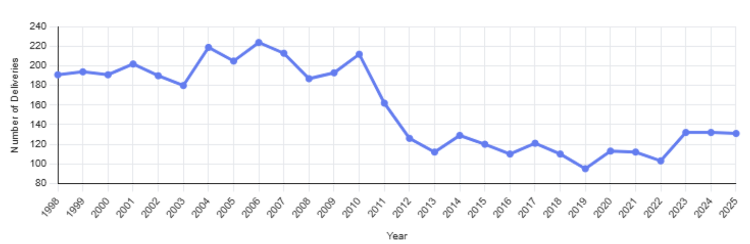
Delivery Volume from 1998-2025
Key Observations
- Peak years occurred around 2004–2007 (highest: 224 deliveries in 2006).
- A clear decline begins after 2010, reaching a low of 95 in 2019.
Recent years (2023–2025) show a partial rebound to ~130 deliveries.
Full Data Table
The following is a table of deliveries at Miles/MaineHealth Lincoln Hospital from calendar years 1998-2025:
| Year | Number of Deliveries |
| 1998 | 191 |
| 1999 | 194 |
| 2000 | 191 |
| 2001 | 202 |
| 2002 | 190 |
| 2003 | 180 |
| 2004 | 219 |
| 2005 | 205 |
| 2006 | 224 |
| 2007 | 213 |
| 2008 | 187 |
| 2009 | 193 |
| 2010 | 212 |
| 2011 | 162 |
| 2012 | 126 |
| 2013 | 112 |
| 2014 | 129 |
| 2015 | 120 |
| 2016 | 110 |
| 2017 | 121 |
| 2018 | 110 |
| 2019 | 95 |
| 2020 | 113 |
| 2021 | 112 |
| 2022 | 103 |
| 2023 | 132 |
| 2024 | 132 |
| 2025 | 131 |
1 - Maine CDC. Infant Mortality in Maine, 2023.CDC National Center for Health Statistics. Vital Statistics Rapid Release, 2024.
2 - Kozhimannil KB et al. Health Affairs. 2025. Kozhimannil KB et al. JAMA. 2024.
According to the Maine Health Data Organization Hospital Encounter Data 2020-2025, in fiscal year 2025, 32% of families living in the Lincoln service area gave birth at MaineHealth Lincoln Hospital. This is up slightly from 30% in 2021.
In the same year, 24% of families in the service area gave birth at MaineHealth Mid Coast Hospital, with the remaining deliveries occurring at MaineHealth Maine Medical Center Portland, MaineGeneral, and other hospitals.
Overall market share patterns have remained relatively stable over time, with births distributed across multiple hospitals rather than concentrated at a single location. Growth in market share at MaineHealth Maine Medical Center Portland and MaineGeneral suggests that families increasingly access delivery care across several hospitals based on geography, clinical needs and personal preference.
Birth data for FY2023-2025
| Hospital | FY23 Market Share | FY24 Market Share | FY25 Market Share |
| MaineHealth Lincoln Hospital | 32% | 33% | 32% |
| MaineHealth Mid Coast Hospital | 30% | 25% | 24% |
| MaineHealth Maine Medical Center | 16% | 17% | 18% |
| MaineGeneral Medical Center Augusta | 14% | 17% | 17% |
| MaineHealth Pen Bay Hospital | 6% | 5% | 5% |
| Central Maine Medical Center | 1% | 0.4% | 1% |
| MaineHealth Franklin Hospital | 0% | 0% | 0.4% |
| Northern Light Maine Coast Hospital | 0% | 0% | 0.4% |
| Northern Light Mercy Hospital | 0.4% | 2% | 0.4% |
| Northern Light Eastern Maine Medical | 0.4% | 0% | 0.4% |
| MaineHealth Waldo Hospital | 0.4% | 0% | 0% |
| Grand Total | 100% | 100% | 100% |
2025 birth data, by town:
| Town | Total Births | Births at MaineHealth Lincoln Hospital | % Delivered at MaineHealth Lincoln Hospital |
| Waldoboro | 37 | 17 | 45.90% |
| Wiscasset | 32 | 6 | 18.80% |
| Jefferson | 24 | 6 | 25.00% |
| Whitefield | 18 | 2 | 11.10% |
| Nobleboro | 15 | 5 | 33.30% |
| Damariscotta | 15 | 11 | 73.30% |
| Boothbay | 13 | 4 | 30.80% |
| Newcastle | 13 | 3 | 23.10% |
| Dresden | 11 | 0 | 0.00% |
| Bristol | 7 | 3 | 42.90% |
| Edgecomb | 7 | 2 | 28.60% |
| Alna | 5 | 2 | 40.00% |
| Boothbay Harbor | 5 | 0 | 0.00% |
| South Bristol | 3 | 2 | 66.70% |
| Bremen | 2 | 1 | 50.00% |
| Trevett | 2 | 0 | 0.00% |
| Round Pond | 2 | 2 | 100.00% |
| New Harbor | 2 | 2 | 100.00% |
| East Boothbay | 2 | 1 | 50.00% |
| Monhegan | 1 | 0 | 0.00% |
| Southport | 1 | 1 | 100.00% |
| Pemaquid | 1 | 0 | 0.00% |
| Total | 218 | 70 | 32.10% |
The eight communities with the highest birth volumes (Waldoboro, Wiscasset, Jefferson, Whitefield, Nobleboro, Damariscotta, Boothbay and Newcastle) accounted for 167 births (76.6% of all service-area births), but only 54 births at MaineHealth Lincoln Hospital. This means MaineHealth Lincoln Hospital captured approximately 32.3% of births from those communities.
Two float positions through the service line are already approved and have been posted. A float pool of OB/GYNs has already been planned by MaineHealth's Southern Region but will require more time to roll out in an immediately available, meaningful way in the Coastal Region. Funding and operationalizing new positions takes time.
A "float pool" model is essentially what we are doing now. The advantage is that we have physicians working here that are already working in the MaineHealth system who have been thoroughly vetted. The disadvantages can be that we have an inconsistent group of doctors rotating through who are unfamiliar with our local hospital/resources.
Due to proximity to other delivery hospitals like MaineHealth Pen Bay Hospital, MaineHealth Mid Coast Hospital, MaineHealth Maine Medical Center Portland and MaineGeneral, patients have more choice about where they would like to deliver. Sometimes, these decisions are driven by a desire to deliver at a site other than their local hospital (some patients are also employees) or by a preference to deliver at a site that has a higher volume.
Further, of the population choosing to delivery at MaineHealth Lincoln Hospital, 2 in 10 develop high risk conditions requiring delivery in Portland. While this number is consistent across other delivery locations, the decrease in volume is more impactful for low delivery volumes at MaineHealth Lincoln Hospital.
By way of great effort, we have built a unit we are proud of. High patient satisfaction, quality and safety, despite low volumes, speak to these efforts. So, it is not surprising that some still seek care here.
Low birth volumes and a high burden of call are the primary drivers we have heard from our candidates. Different call models exist, but the bottom line is that 1:4 call comes to 91 days of call per year.
Another difficulty we have encountered is the inability to support a new graduate due to the high volumes required to complete their board certification.
The continued use of contracted, per diem providers presents a problem. Contracted, and some per diem, physicians are not contractually bound to continue delivering care as employed physicians. We have been creatively staffing the unit for years and have reached a point at which per diem availability is becoming increasingly challenging, which necessitates the need for obstetric patient diversion with little notice to the community. Diversion has become more common in the last two years.
It's an understandable comparison because all of these services are important to a community. There are, however, important differences.
Fire and police departments are publicly funded to provide emergency readiness and their teams respond to a wide range of incidents every day. Hospitals operate under a different funding model, with services primarily supported through reimbursement for the care they provide.
At the same time, labor and delivery services require a dedicated team of highly specialized clinicians—including obstetricians, certified nurse midwives, labor and delivery nurses, anesthesiologists, pediatric providers and surgical support—who must be available 24 hours per day, 365 days per year, regardless of how many births occur.
Maintaining that level of readiness depends on more than keeping a unit open. It requires the ability to recruit and retain specialized clinicians, support them with sufficient clinical experience, and ensure they can safely provide care at any hour. That is why decisions about maternity services consider many factors—including workforce, patient safety, quality, utilization and long-term sustainability—not any single measure alone.
Community questions as of June 30, 2026
The most significant funding opportunity is the Rural Health Transformation Program. On December 29, 2025, the U.S. Centers for Medicare & Medicaid Services (CMS) notified the State of Maine that it will receive $190 million for Year 1 of the federal Rural Health Transformation Program, which was established through the passage of H.R. 1.
The State of Maine has announced plans to invest these funds across five different initiatives, including workforce. Of the money the State expects to receive, approximately $12.5 million has been allocated to the Finance Authority of Maine (FAME) for recruitment and retention of licensed health care professionals. Details regarding specific programs and eligibility requirements have not yet been released, but it is our understanding that FAME intends to issue $50,000 incentive payments to recruit licensed health care professionals to rural Maine and to support those training to become a licensed health care professional.
Recruitment and retention costs for physicians, particularly specialists, often substantially exceed $50,000 when accounting for relocation expenses and student loan debt, as two examples. As a result, these funds may help support workforce development and recruitment efforts for certain licensed professionals but are not likely to resolve immediate recruitment challenges for physicians and specialists.
MaineHealth has led a federal grant – RMOMS – that is looking at ways to improve access to labor and delivery services in rural areas. MaineHealth Lincoln Hospital has participated in this grant, implementing remote monitoring for postpartum hypertension, participating in an orientation program where OB RN learners from MaineHealth Pen Bay and Lincoln Hospitals come together for shared learning opportunities, and participate in simulation training for skills improvement.
In December 2024, Maine DHHS was awarded a Transforming Maternal Health (TMaH) grant from CMS. The State expects to receive up to $17 million in funding over 10 years to improve maternal health care for women enrolled in MaineCare and the Children’s Health Insurance Program (CHIP). As part of this work, Regional Rural Planning Groups were created and are scheduled to start a two-year planning process on June 25, 2026. MaineHealth Lincoln Hospital serves on the District 4 Planning Group. This initiative represents an important long-term investment in maternal health, but it is not designed to address immediate provider recruitment needs.
Community questions as of June 10, 2026
The National Institute of Health reports 200 births annually to be sustainable, if there are enough OB/GYN providers on staff. The average annual birth volume at MaineHealth Lincoln Hospital is around 130, with an average of only 18 deliveries per provider.
Because the volume is low, we have been challenged to recruit providers and have not been able to recruit an OB/GYN since 2020. As a result, we currently rely on contracted providers, who work elsewhere, to provide coverage at MaineHealth Lincoln Hospital.
This model has not proven to be sustainable, and we have been forced to go on diversion more frequently in the past year because coverage cannot be secured. Not having predictable coverage does not promote patient safety and is not patient-centered care.
We continue to promote the maternity program through social media, birth announcements, press releases, community events and community class offerings—including childbirth classes for parents and new moms play groups, whether they choose to deliver at MaineHealth Lincoln Hospital or not. These efforts have not led to a significant increase in births over the years.
Alternative staffing models have been discussed with the steering committee, assessment work groups and the MaineHealth Lincoln Hospital board. To be clear, the cost of care, including staffing, is not the challenge – it is the inability to recruit providers given the high call ratio and low birth volume.
MaineHealth Lincoln Hospital care team members, including providers, have been involved with the assessment of labor and delivery services. Our ongoing communication with providers and care team members continues to inform the conversation, and we have been transparent about the discussions that are taking place during the assessment process.
The forums were designed for us to listen to and consider your perspectives during this assessment process. As a final recommendation has not been made from the assessment, no one should have been told that labor and delivery services are ending.
Labor and delivery is the only reproductive service being assessed. MaineHealth is committed to keeping prenatal and postnatal care at MaineHealth Lincoln Hospital and is seeking to improve access to other gynecological services.
According to a published study on choice of birthing location, results showed the following as the most influential: Safety vs. Risk; Influence of Family, Friends and Media; Presence or Absence of Choice; and Control and Access to Options.
While MaineHealth can educate patients and providers about available services, physicians exercise independent medical judgment when recommending where a patient receives care. Referral decisions are based on patient needs, provider recommendations, and patient choice, not health system mandates.
Yes. MaineHealth Lincoln Hospital has physicians who are trained to perform emergency deliveries. They participate in regular simulation training to maintain their skills in responding to obstetric emergencies.
Care team members have been actively engaged throughout the assessment process through committee meetings, town hall meetings, leader discussions, email updates, and frequently asked questions. In addition, physicians, advanced practice providers, nurses and other team members have had opportunities to share feedback, ask questions, and offer perspectives on potential options and challenges facing the Family Birth Center at MaineHealth Lincoln Hospital.
No care team members from labor and delivery are receiving severance pay.
Community questions as of June 3, 2026
MaineHealth Lincoln Hospital is conducting a review of its obstetrics program due to ongoing OB/GYN recruiting challenges and the impact of low birth volume.
No. We are looking at ways to redesign labor and delivery services to better meet the needs of our communities within the realities of our recruitment challenges and low birth rates at the hospital.
MaineHealth has no plans to close services at MaineHealth Lincoln Hospital at this time. MaineHealth has invested more than $20 million to improve and expand access to important services such as infusion therapy and integrated primary care at MaineHealth Lincoln Hospital.
Of the 11 labor and delivery closures at Maine hospitals in the last decade, only two reduced services, neither of which were MaineHealth hospitals.
In addition, we are constantly reviewing opportunities to expand services to better meet the needs of the communities we serve. For example, we are currently embarking upon a review of GYN services, as there is an unmet need in Lincoln County.
Updated June 30, 2026
Today, 67 percent of Lincoln County’s expectant moms delivered their babies somewhere other than MaineHealth Lincoln Hospital – including MaineHealth Pen Bay Hospital, MaineHealth Mid Coast Hospital, Maine General and MaineHealth Maine Medical Center.
While travel time is important, this data shows that for many it is not a deciding factor guiding decision-making.
The average drive time for residents of Lincoln County would increase by 18 minutes or less. While a closure scenario would increase travel times, impacts vary by town and are modest for most patients.
| Average Drive Time | Longest Drive Time | Drive Time Range | |
| Current State | 19 minutes | 33 minutes | 3-33 minutes |
| Closure Scenario | +18 minutes 39 minutes total | +20 minutes 53 minutes total | 20-53 minutes |
In a closure scenario, only a small subset of patients would experience a drive time of over 50 minutes:
- 86% would have a drive time of 39 minutes or less
- 12% would have a drive time of 40-49 minutes
- 2% would have a drive time of 50 minutes or longer
We expect to complete our assessment by the end of June. Recommendations will be shared in July with the local community board for advisement before going to the Coastal Region board. Only the MaineHealth Board has the authority to approve any change, and they meet in August.
Updated June 30, 2026
We have been working closely with the maternity team to keep them informed and to incentivize them to stay while we complete this process. If changes to the service are made, we have plans in place to support team members in finding new opportunities. We have many openings available, and we are confident that we can retain anyone who may be impacted if change occurs.

"At MaineHealth Lincoln Hospital, we are focused on providing safe, high-quality and sustainable care for our communities. We recognize how important labor and delivery services are to our patients, families and communities, and we are committed to listening carefully and communicating openly throughout this process."
- Cindy Wade, President, MaineHealth Lincoln Hospital
Forums were held in Damariscotta and Boothbay Harbor
| When | Where |
| Monday, June 1, 2026 5 - 6:30 pm | Boothbay Region Elementary School Gymnasium* |
| Tuesday, June 2, 2026 5 - 6:30 pm | Great Salt Bay School Gymnasium |
* This event was not sponsored by the Boothbay-Boothbay Harbor Community School district, nor did it necessarily represent the values and opinions of the Board of Trustees, the Boothbay-Boothbay Harbor School Committee, or the school community at large.
Questions?
If you have additional questions, please email us at LincolnFeedback@mainehealth.org.