Peter Brooks, PhD
Research
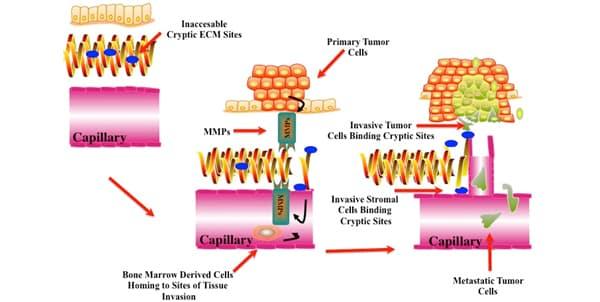
Our laboratory’s primary research interests are centered on studying how integrin-mediated cellular communication with cryptic ECM sites exposed following the triggering of biomechanical extracellular matrix (ECM) switches regulates angiogenesis, inflammation, tumor growth and metastasis. In this regard, we use several in in vitro and in vivo animal models of angiogenesis, Inflammation, tumor growth and metastasis. Our ongoing research program is focused on translating our basic research finding into clinically relevant and innovative new strategies for the early detection and treatment of malignant tumors such as metastatic prostate, breast and ovarian carcinoma as well as melanoma. Emerging experimental findings suggest that selective conformational changes in the three-dimensional structure of ECM proteins such as collagen may help create a tumor permissive niche within the tissue microenvironment that is used by both stromal cells and tumor cells to gain growth and migratory advantages (Fig1).
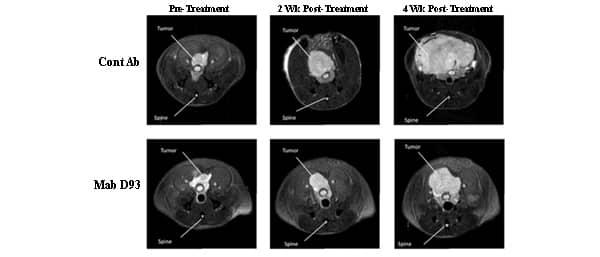
We have generated a number of specific peptide and antibody antagonists that are specifically directed to non-cellular cryptic ECM epitopes to help investigate the functional role of these unique ECM sites during invasive cellular processes. To begin to assess the novel strategy of blocking cellular interactions with these cryptic ECM sites might have on tumor growth, we use a number of tumor and metastasis models. As shown in Fig 2, treatment of TRAMP mice with humanized Mab D93 inhibited the growth of prostate cancer in TRAMP mice.
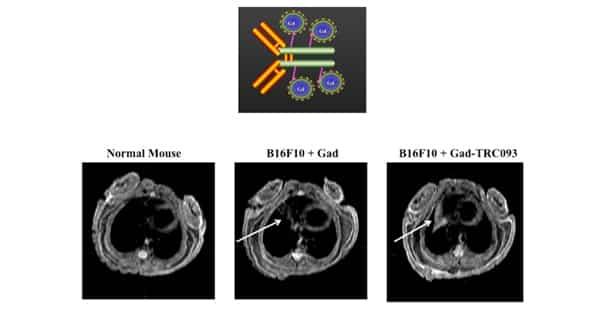
Given the selective triggering of unique biomechanical ECM switches during tumor invasion, we are currently examining whether selective targeting of these cryptic ECM sites might be exploited to develop more sensitive imaging modalities to detect tissue remodeling. In a preliminary study (Fig 3), our novel Gadolinium conjugated Mab D93 enhanced the detection of metastatic melanoma lesions in mice following MR imaging as compared to free Gadolinium contrast agent.
Background & Experience
BS: University of Maine, Orono
PhD: Cellular & Developmental Biology, SUNY Stony Brook
Postdoctoral Training: Scripps Institute
Lab Members



Selected Publications
A complete list of publications can be found on My NCBI
Yang, X., Liaw, L., Prudovsky, I., Brooks, P. C., Vary, C., Oxburgh, L., and Friesel, R. FGF signaling in the vasculature. Curr. Ather. Reports. 17(6): 509.doi: 10.1007/s11883-015-0509-6. 2015.
Young K, Tweedie E, Conley B, Ames JJ, FitzSimons M, Brooks P. C., Liaw L, Vary CPH. BMP9 crosstalk with the Hippo pathway regulates endothelial cell matricellular and chemokine responses. PLoS ONE. 10(4):e0122892. doi: 10.137. /journal.pone.0122892. eCollection 2015.
Duarte, C. W., Murray, K., Lucas, F. L., Fairfield, K., Miller, H., Brooks, P. C., and Vary, P. H. Improved survival outcomes in cancer patients with hereditary hemorrhagic telangiectasia. Caner Epidemiol. Biomarkers Prev. 23: 117-125. 2014.
Fravreau, A. J., Vary, C. P. H., Brooks, P. C., and Sathyanarayana, P. Cryptic collagen IV promotes cell migration and Adhesion in Myeloid Leukemia. Cancer Med. 2: 265-272. 2014.
Contois, L. W., Akalu, A., Caron, J. M., Tweedie, E., Cretu, A., Henderson, T., Liaw, L., Friesel, R. E., Vary, C. P. M., and Brooks, P. C. Inhibition of tumor associated avb3 integrin regulates the angiogenic switch by enhancing expression of IGFBP-4 leading to reduced melanoma growth and angiogenesis in vivo. Angiogenesis. Doi: 10.1007/s10456-014-9445-2. 2014.
Gong, Y., Yang, X., He, Q., Gower, L., Prudovsky, I., Vary, C. P. H., Brooks, P. C., and Friesel, R. E. Sprouty-4 Regulates endothelial cell migration via modulating regulating integrin b3 stability through c-src. Angiogenesis; 16: 861-875. 2013.
Contois, LW., Nugent, DP., Caron, JM., Cretu, A., Tweedie, E., Akalu, A., Liebes, L., Friesel, R., Rosen, C., Vary, C., and Brooks, PC. Insulin-like growth factor binding protein-4 (IGFBP-4) differentially inhibits growth factor-induced angiogenesis. J. Biol. Chem.; 287:1779-1789. 2012.
Professional Activities
- Member of Editorial Board of Angiogenesis Research
- Member of the Editorial Board of Journal of Cellular Physiology
- Reviewer NIH Developmental Therapeutics Study Section
- Reviewer NIH Vascular Cell and Molecular Biology Study Section
- Reviewer NIH Tumor Progression and Metastasis Study Section
- Scientific Consultant and SAB member of ImmunoCell Therapeutic.
- Scientific Consultant and SAB member of Paganini BioPharma.
- Co-Founder, Scientific Consultant and SAB member of CryptoMedix LLC.