Katherine Motyl, PhD
Research
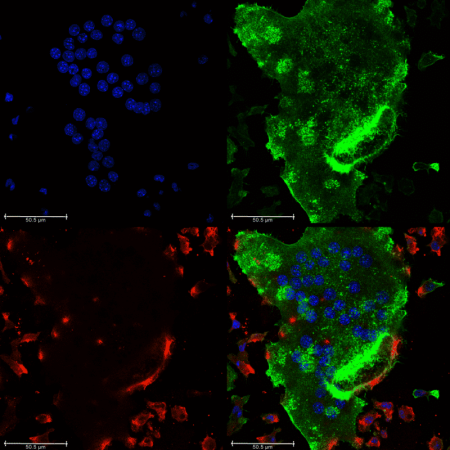
The Motyl laboratory is broadly interested in how the nervous system regulates bone turnover. Bone is a dynamic tissue, which is constantly being broken down (bone resorption) and rebuilt (bone formation). Many local and systemic factors regulate bone turnover, including signals from the nervous system. We have specific interests in understanding the role of bone-resorbing osteoclasts in neural-mediated bone changes, and identifying feedback loops regulating neural output to bone. Our work has implications for the natural aging process, as well as for people taking medications that influence the central nervous system, like β-blockers and opioids.
Confocal image of an osteoclast expressing β-adrenergic receptor. Cells were isolated from the bone marrow of 6-week old mice and cultured for five days in osteoclast-differentiation media. Images were acquired at 63x magnification and staining was performed for the following: DAPI (nucleus; blue), Phalloidin (F-actin; green), and β-adrenergic receptor (anti-β-adrenergic receptor antibody; red). Pictured are three individual fluorescence channels and a composite overlay of all channels (bottom right corner). Osteoclasts form when precursor cells fuse together, resulting in large multinucleated cells that form a “sealing zone” and release several factors that break down the bone matrix.
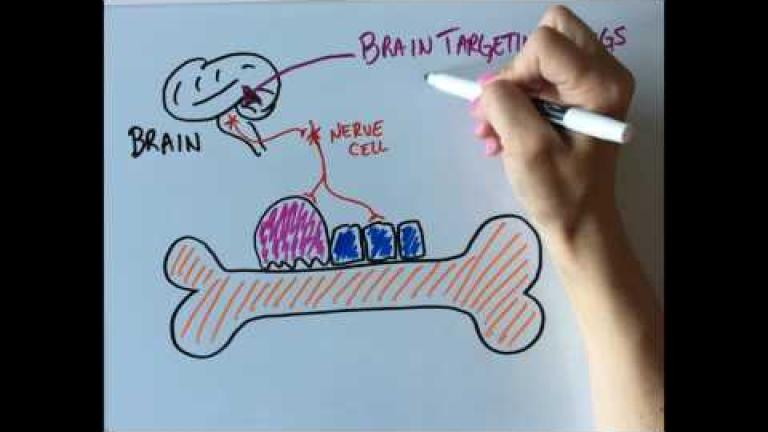
The Motyl Lab Science Sketch video below demonstrates how the metabolic consequences of antipsychotic drugs relate to changes in bone remodeling.

Selected Publications
A complete list of publications can be found on My NCBI
Motyl KJ, Beauchemin M, Barlow D, Le PT, Nagano K, Treyball A, Contractor A, Baron R, Rosen CJ, Houseknecht KL. A novel role for dopamine signaling in the pathogenesis of bone loss from the atypical antipsychotic drug risperidone in female mice. Bone. 2017; 103:168-176. PMID: 28689816
Carvalho AL, DeMambro VE, Guntur AR, Le P, Nagano K, Baron R, de Paula FJA, Motyl KJ. High fat diet attenuates hyperglycemia, body composition changes, and bone loss in male streptozotocin-induced type 1 diabetic mice. Journal of Cellular Physiology. 2017; PMID: 28631813
Motyl KJ, DeMambro VE, Barlow D, Olshan D, Nagano K, Baron R, Rosen CJ, Houseknecht, CJ. Propranolol attenuates trabecular bone loss in female mice from the atypical antipsychotic, risperidone. Endocrinology. 2015; 156(7):2374-83. PMID: 25853667. **highlighted in Endocrine News.
Zhang J, Motyl KJ, Irwin R, MacDougald OA, Britton RA and McCabe LR. Loss of bone and Wnt10b expression with type 1 diabetes is blocked by the probiotic L. reuteri. Endocrinology. 2015; 156(9):3169-82.
Devlin MJ, Van Vliet M, Motyl K, Karim L, Brooks DJ, Louis L, Conlon C, Rosen CJ, Bouxsein ML. Early-onset type 2 diabetes impairs skeletal acquisition in the male TALLYHO/JngJ mouse. Endocrinology. 2014. Oct;155(10):3806-16. PMCID: PMC4164927.
Motyl KJ, Bishop KA, Demambro VE, Bornstein SA, Le P, Kawai M, Lotinun S, Horowitz MC, Baron R, Bouxsein ML, Rosen CJ. Altered thermogenesis and impaired bone remodeling in Misty mice. J Bone Miner Res. 2013. 28(9):1885-97. PMCID: PMC3743939.
Calarge CA, Ivins SD, Motyl KJ, Shibli-Rahhal AA, Bliziotes MM, and Schlechte JA. Possible mechanisms for the skeletal effects of antipsychotics in children and adolescents. Therapeutic Advances in Psychopharmacology. 3(5): 278-93. 2013. PMCID: PMC3805387.
Appointments & Activities
Academic Appointments
- Faculty Scientist II, MaineHealth Institute for Research, Scarborough, ME
- Graduate Faculty, Graduate School of Biomedical Sciences and Engineering, University of Maine, Orono, ME
- Assistant Professor, Department of Medicine, Tufts University School of Medicine, Boston, MA.
Professional Activities
- Member, Editorial Board, Endocrinology
- Member, American Association for the Advancement of Science
- Member, American Society for Bone and Mineral Research
- Member, The Endocrine Society
- Member, Society for Neuroscience